If you want an app on both iPhone and Android, one of the first decisions is how to build it: as two native apps, or as one cross-platform app that runs on both. The choice affects your budget, your launch date and how easy the app is to maintain. Here is how to decide.
What native and cross-platform mean
Native apps
A native app is built separately for each platform using its own language and tools: Swift for iOS and Kotlin for Android. You get two codebases, each tuned to its platform.
Cross-platform apps
A cross-platform app shares most of its code between iOS and Android. The most common frameworks are Flutter, from Google, and React Native, from Meta. Kotlin Multiplatform is a newer option that shares business logic while keeping native interfaces.
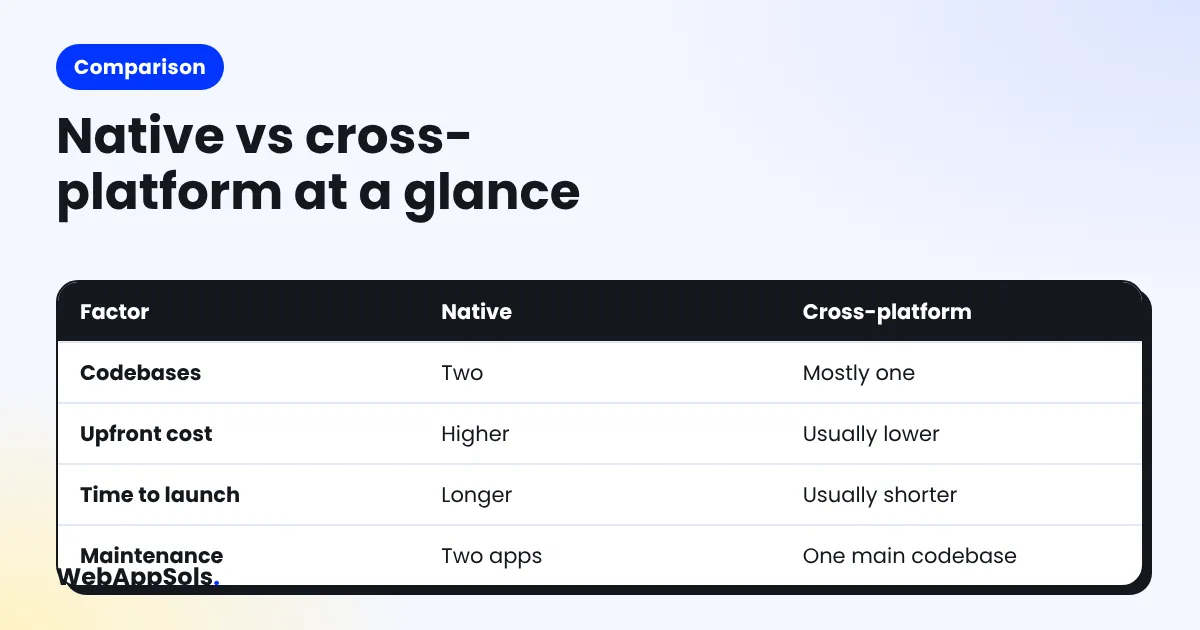
Native vs cross-platform at a glance
| Factor | Native (Swift + Kotlin) | Cross-platform (Flutter, React Native) |
|---|---|---|
| Codebases | Two | Mostly one |
| Upfront cost | Higher | Usually lower |
| Time to launch on both stores | Longer | Usually shorter |
| Performance | Best for heavy graphics and real-time work | Strong for most business apps |
| New OS features | Available immediately | May wait for framework support or need native code |
| Maintenance | Two apps to update | One main codebase plus some platform code |
When native development makes sense
- The app depends heavily on device hardware: advanced camera work, Bluetooth accessories, AR or background location.
- Performance is critical, as in games or real-time audio and video.
- You need new iOS or Android features on day one.
- You have, or plan to hire, separate iOS and Android teams.
When cross-platform is the better choice
- You want to launch on both platforms quickly and on one budget.
- The app is mostly forms, lists, bookings, payments, messaging or dashboards, which describes most business apps.
- You are building an MVP to test demand before investing more.
- You want one team to maintain one codebase.
Questions to ask before you decide
- Which device features does the app need on day one, and which can wait?
- Do you need both platforms at launch, or can you start with one?
- What is your first-year budget, including maintenance?
- Who will maintain the app after launch?
- Does the app need to share code or design with a web app?
If app-store presence is not essential, a progressive web app (a website that installs like an app) is also worth considering.
How the choice affects cost and timeline
Cross-platform development usually costs less upfront because most code is written once. Native costs more but can be cheaper over time if the app's core features fight against a framework. Our guide to the app development process and cost covers the other factors that move the budget. When you are ready to launch, see how to publish your app on both stores.
How we approach it at WebAppSols
We build native apps with Swift and Kotlin and cross-platform apps with Flutter, and design the interface first through UI/UX design so the app is tested before code is written. Our recommendation comes in the written quote, with the reasons for it. App work such as City Rides and Epicnap is in our case studies.
Frequently asked questions
Is Flutter or React Native better?
Both are mature and widely used. Flutter draws its own interface and gives very consistent results across devices; React Native uses native components and suits teams with JavaScript experience. The better choice depends on your app and team.
Is a cross-platform app slower than a native app?
For most business apps, users will not notice a difference. Gaps show up mainly in graphics-heavy or real-time apps.
Can I switch from cross-platform to native later?
Yes, but it usually means rebuilding the app. Choosing carefully at the start, or isolating hardware-heavy features in native modules, reduces that risk.
Should I launch on iOS and Android at the same time?
If your customers use both, yes, and cross-platform makes that easier. On a tight budget, launching first on the platform most of your customers use is a valid approach.
Need help with this?
Not sure which approach fits your app? Tell us what it needs to do and we'll recommend one in a written quote. Mobile app projects start from $3,750 on your first order.