A website design brief is a short document that explains what you want your website to achieve. It is the single best way to get accurate, comparable quotes and a site that fits your business. It does not need to be long or technical; two pages of clear answers beat twenty pages of jargon.
Why a website brief matters
- Comparable quotes: every company quotes on the same information.
- Fewer surprises: features you need are priced from the start.
- Faster projects: designers spend less time guessing and more time designing.
- A yardstick: you can check the finished site against what you asked for.
What to include in a website design brief
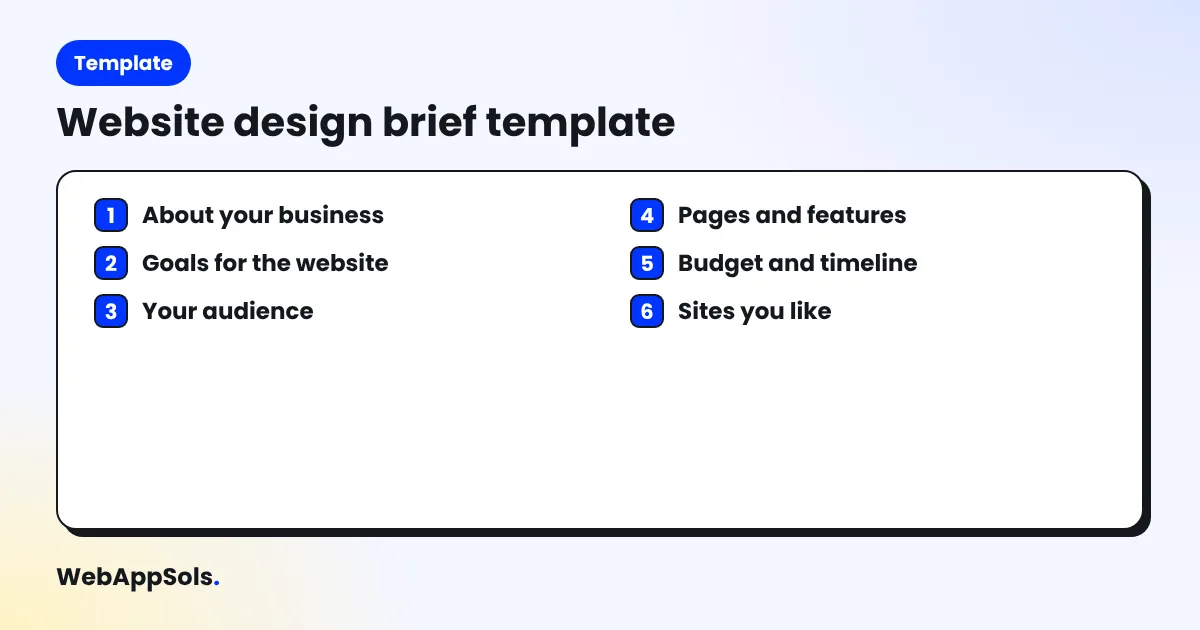
About your business
What you do, who you serve, where you operate, and what makes you different. One paragraph is enough.
Goals
What the website must achieve, ideally in measurable terms: more calls, booked appointments, online sales, quote requests, or credibility for referrals.
Audience
Who visits, what they need to know before contacting you, and which questions they ask most often.
Pages and features
List the pages you expect (see pages every small business website needs) and features such as forms, booking, payments, a blog, multilingual content or integrations with your CRM.
Brand and style
Share your logo, colors and fonts, or say you need them; a logo design package can come first. Add two or three websites you like and say why, plus any you dislike.
Content
Who will write the text and provide photos? Which content from your current site should carry over?
Technical details
Do you own a domain? Who hosts the current site? Which platform, if any, do you prefer, and who will edit the site after launch?
Budget, timeline and decision-makers
Give a budget range; it lets companies propose the right solution rather than guess. Note any fixed deadline, and name the person who approves work.
Free website design brief template
Copy these questions into a document and answer each one in a few sentences:
- What does your business do, and who are your main customers?
- What is the main goal of the website? What should visitors do?
- How will you measure whether the website is working?
- Who are your main competitors online?
- Which three websites do you like, and why?
- Which pages do you need at launch?
- Which features do you need (forms, booking, payments, blog, logins, integrations)?
- Do you have a logo and brand guidelines?
- Who will provide the text and images?
10. Do you own your domain, and where is your current site hosted?
11. What is your budget range and target launch date?
12. Who will give feedback and approve the work?
Tips for a brief that gets better results
- Describe problems, not solutions: "customers keep calling to ask our prices" is more useful than "add a pricing table."
- Separate must-haves from nice-to-haves so quotes can be phased.
- Be honest about budget; a good company will tell you what is realistic.
- Keep it short. Answers to the 12 questions are usually enough.
Once your brief is ready, use our guide on how to choose a web design company to compare the responses, and check what drives website costs so quotes make sense.
Frequently asked questions
How long should a website design brief be?
One to three pages is typical. Clarity matters more than length.
Should I include my budget in the brief?
Yes. A budget range helps companies recommend the right approach instead of quoting an option you cannot afford or underestimating what you need.
What if I don't know what features I need?
Describe what you want customers to be able to do, for example "book a consultation online." A good designer will translate that into features.
Is a design brief the same as a contract?
No. The brief is your request. The company's written scope or proposal, based on your brief, is what you agree to.
Need help with this?
Filled in the template? Send it with your quote request and we'll reply with questions and a written plan. New clients get 50% off their first order.